

Surveillance State
THE BAYSIDE STORY DIDN’T NEED ALIENS. THE DOMESTIC SURVEILLANCE MACHINE WAS ALREADY REAL.
Audio edition
The Bayside extraction theory is not established by public records, but the surveillance and domestic-force architecture around it is very real.
The Bayside extraction theory is not established by public records.
That is not the end of the story.
The theory got traction because it described something real: military support to civilian law enforcement, domestic cell-site simulators, federal secrecy agreements, integrated command networks, intelligence-community assistance, and a federal court ruling in 2025 that U.S. troops were used to execute domestic law.
The timeline
Congress draws the line
Congress passes the Posse Comitatus Act. Today, 18 U.S.C. § 1385 bars willful use of federal military forces to execute domestic law except where the Constitution or Congress expressly authorizes it. The rule is clear. The exceptions are where the story starts.
The military-support pipeline opens
GAO later described the 1981 amendments as designed to remove restrictions and ambiguities and facilitate cooperation between military and civilian law-enforcement officials. Not direct policing. Support. That little word does a lot of work.
Support becomes infrastructure
10 U.S.C. § 284 allows support for counterdrug and counter–transnational organized crime missions, including command, control, communications, and computer networks integrating law enforcement, active military, and National Guard activities.
The data bridge is written down
10 U.S.C. § 271 allows DoD to provide civilian law enforcement with information collected during normal military training or operations, and says law-enforcement information needs should be considered in military planning.
The direct-participation line remains
10 U.S.C. § 275 bars direct military participation in searches, seizures, arrests, or similar law-enforcement activity under that chapter. The restriction exists beside the support authorities, not instead of them.
Cell-site simulators are already in play
EPIC’s FOIA litigation states that the FBI has used cell-site simulator technology to track and locate phones and users since at least 1995. The technology did not arrive with TikTok panic. It had decades of quiet institutional use behind it.
DOJ and DHS write domestic policy
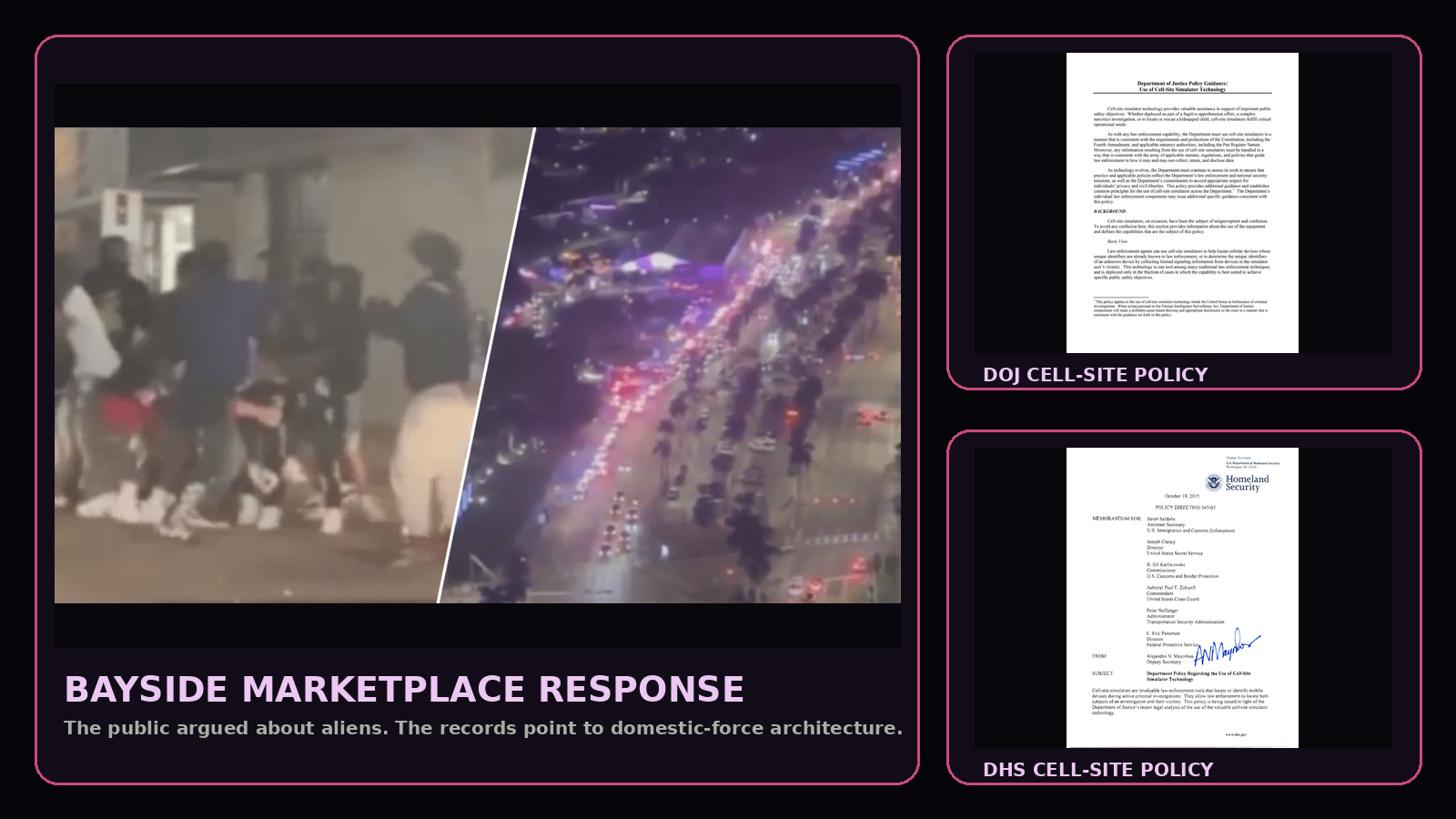
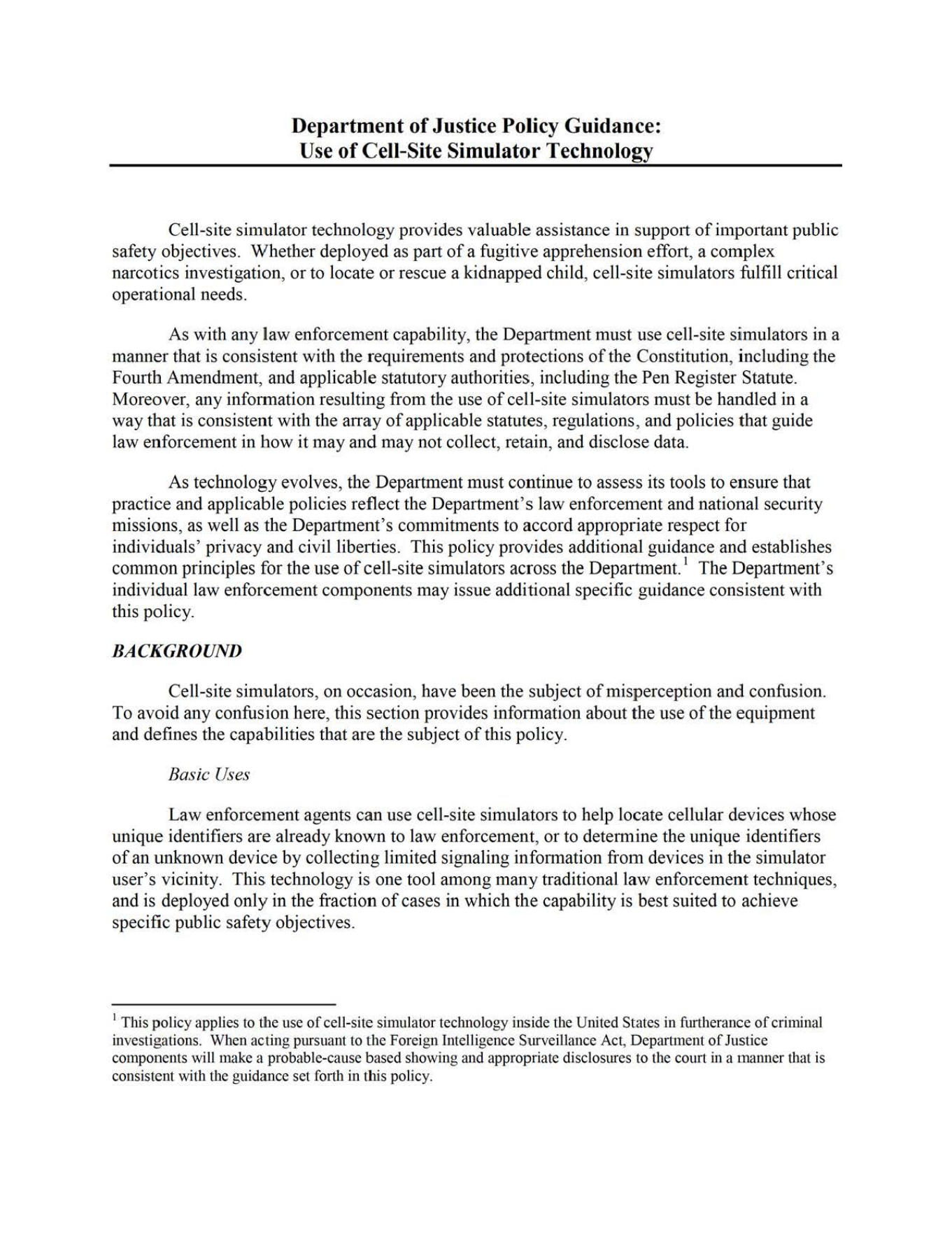
DOJ says cell-site simulators force nearby cellular devices to identify them as the strongest cell tower and transmit identifying information. DHS issues its own domestic-use policy the same year.
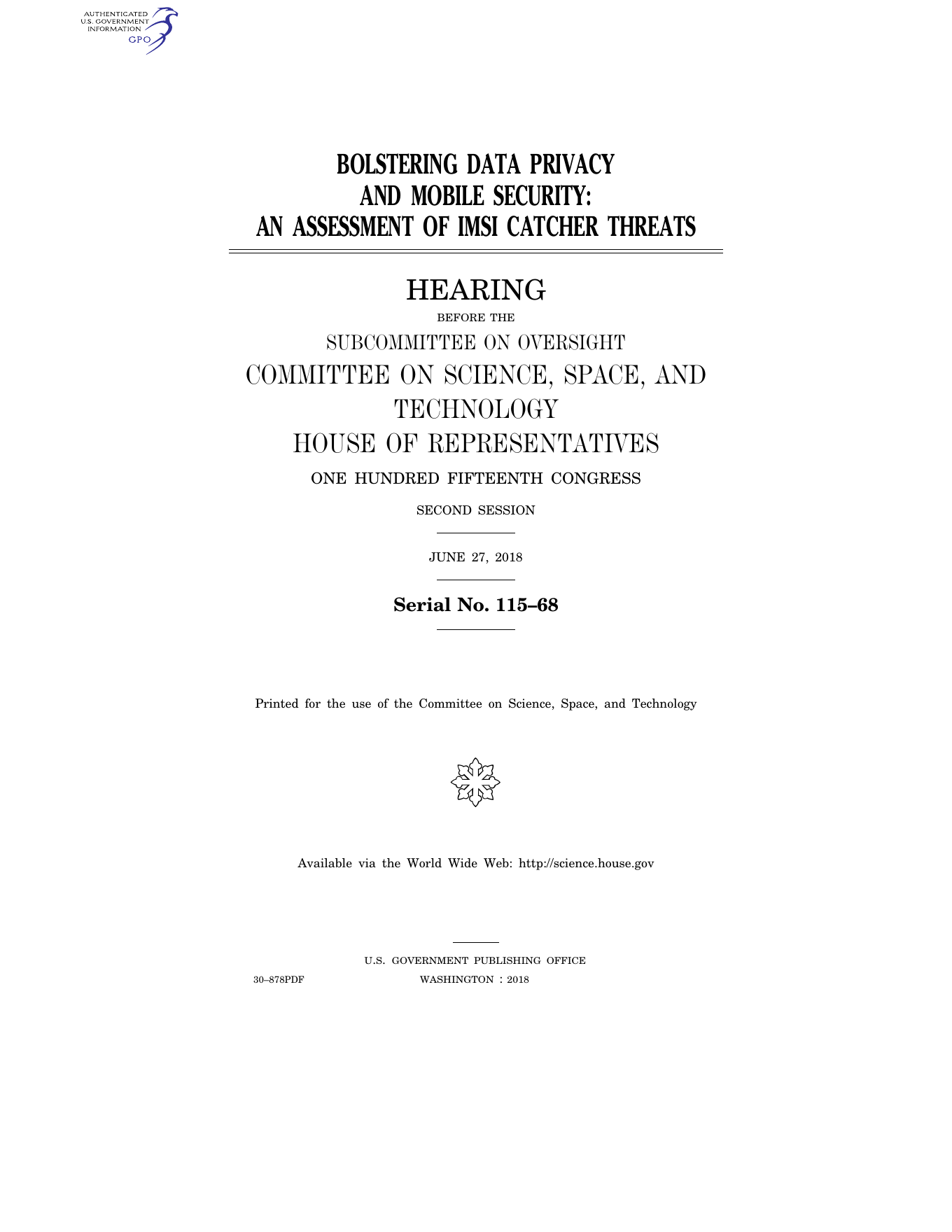
Congress holds an IMSI-catcher hearing
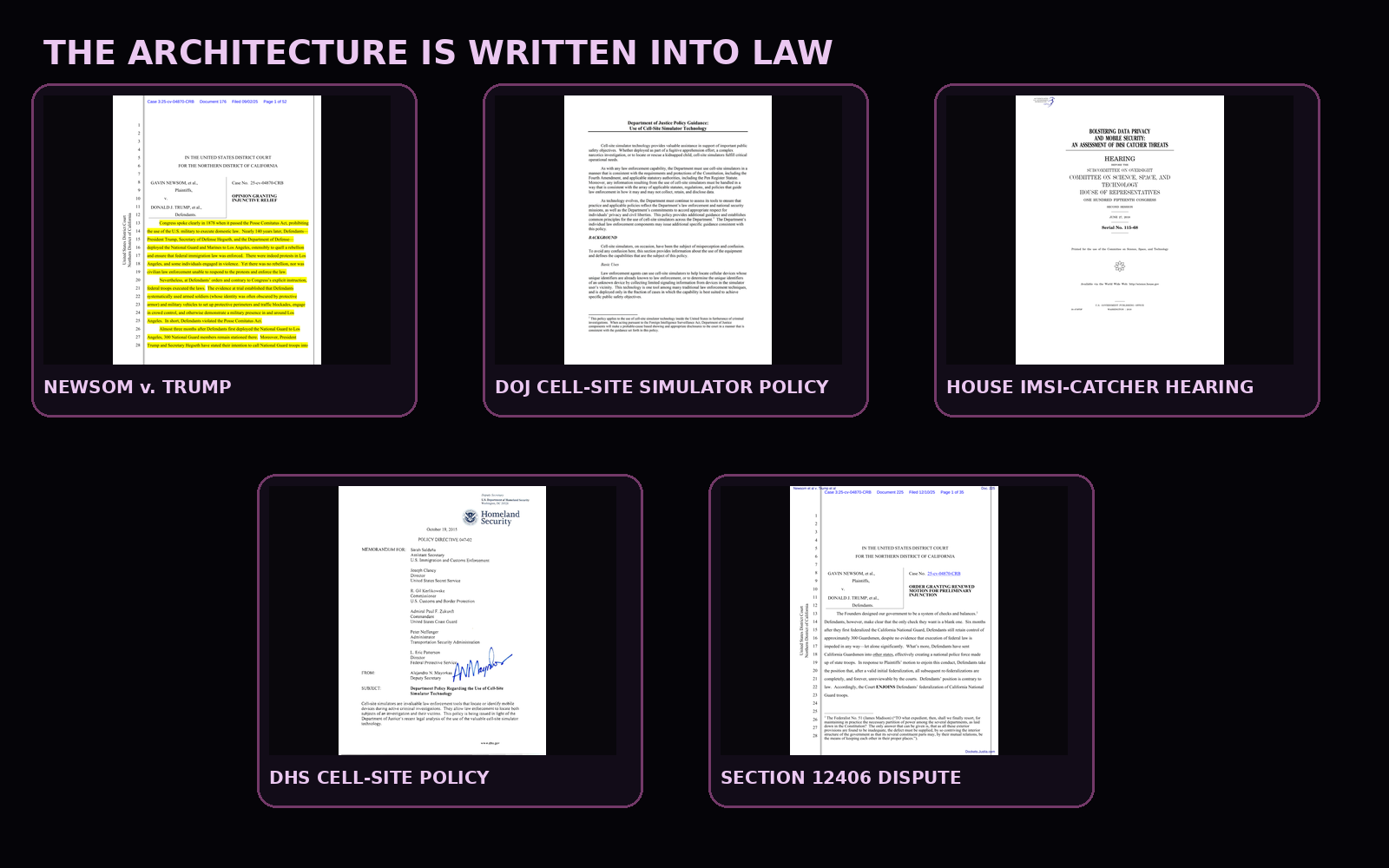
The House Science Committee holds Bolstering Data Privacy and Mobile Security: An Assessment of IMSI Catcher Threats. NIST, Princeton, and Virginia Tech witnesses testify. Congressional leadership had already been warned.
The Washington, D.C. concern surfaces
The National Security Archive publishes a document set showing congressional and agency concern over IMSI-catchers in Washington, D.C., including a network uncovered as early as 2014 and rediscovered in 2017.
Bayside becomes a viral event
The public saw a huge police perimeter and an alien rumor. The claim inventory said the real issue was a High-Intensity Tactical Extraction operation hidden behind a riot narrative and informational poisoning.
A federal court says the line was crossed
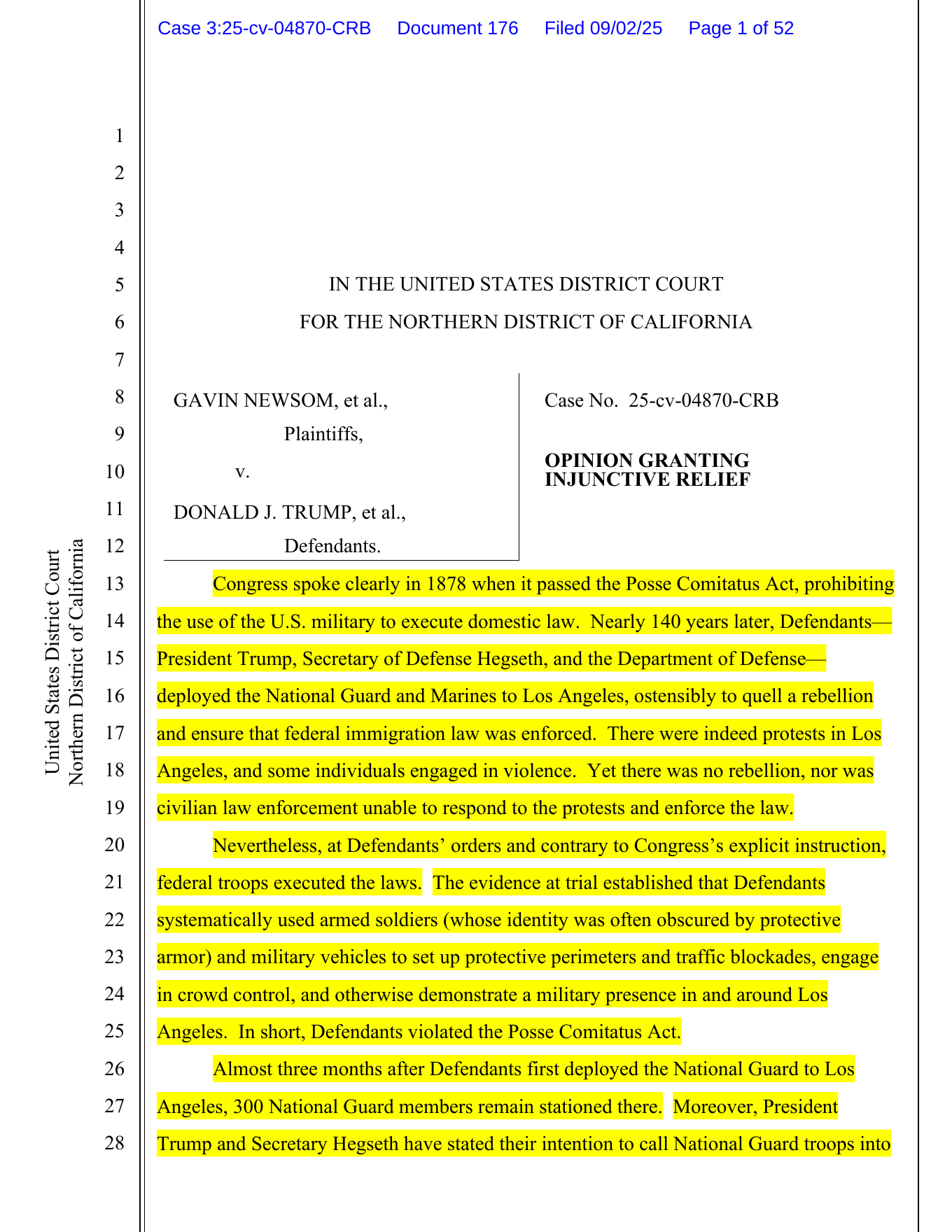
Judge Charles Breyer rules in Newsom v. Trump that federal troops executed domestic law in Los Angeles, citing perimeters, traffic blockades, crowd control, and military presence.
The fight is still active
A later order details continued federalization disputes involving California, Oregon, and Illinois, and describes the government’s expansive view of presidential deployment powers under 10 U.S.C. § 12406.
Claims on the record
The Bayside claim is specific. It is not just “phones were weird” and spooky mall footage. It is a stack of claims, each one doing a different job.
The Miami Bayside incident was allegedly a High-Intensity Tactical Extraction operation carried out by a multi-agency federal task force, with local police used as the visible perimeter shield while the real operation happened inside the mall infrastructure.
The public allegedly did not witness a normal riot response. It witnessed containment of a high-value asset.
The first “firework” was allegedly followed by EMP, jamming, interception, or signal control, explaining the lack of clear close-up smartphone footage from a crowded public location.
Devices near the scene were allegedly forced into a controlled signal environment where identifiers, connections, and data could be managed.
The “8-to-10-foot shadow beings” were allegedly Advanced Tactical Camouflage Units: human operators using active camouflage, refractive materials, or signature-distortion systems that made them appear tall, blurred, and non-human.
The airport disruption rumor was allegedly a temporary control measure to prevent drones, helicopters, private aircraft, or news cameras from recording the extraction from above.
The alien story was allegedly not the truth. It was the poison. Once the public argued about aliens, the extraction question became socially untouchable.
What happened
For nearly fifty years, the old civilian-protection rule has been converted into a permission system.
The wall said: the military is not domestic police.
The permission system says: intelligence support, reconnaissance support, equipment support, communication networks, information-sharing, technical assistance, and specialized personnel are available if the correct authority is invoked.
That distinction matters.
The public thinks Posse Comitatus means separation.
The statute says separation with exceptions.
The support statutes say integration.
10 U.S.C. § 284 does not merely allow trucks and tents. It authorizes command, control, communications, and computer networks for improved integration of law enforcement, active military, and National Guard activities. It authorizes intelligence analysis. It authorizes aerial and ground reconnaissance.
10 U.S.C. § 271 does not merely permit accidental information-sharing. It says civilian law-enforcement information needs should be considered in military planning, and that relevant DoD intelligence information should be provided to civilian law enforcement.
Executive Order 12333 does not place the Intelligence Community outside law enforcement. Section 2.6 allows intelligence agencies to participate in law-enforcement activities involving foreign powers, international terrorism, or narcotics, and to provide specialized equipment, technical knowledge, or expert personnel.
Cell-site simulators are not speculative.
DOJ and DHS policies describe them. EPIC litigation documents decades of use. ACLU identifies dozens of agencies with the technology. House hearings treated IMSI-catchers as a national-security and privacy threat.
And when the public sees a huge police response with missing or unclear evidence, some people now reach for the most extreme explanation because the moderate explanation no longer matches the documented machinery.
Why this matters
The easiest move is to mock Bayside and stop there.
That move protects the machine.
If the only question is “were there aliens at Bayside,” the answer is easy.
No.
If the question is “does the U.S. have documented domestic surveillance and military-support architecture that makes a federal operation in civilian space plausible in principle,” the answer is also easy.
Yes.
The official narrative survives by collapsing those two questions into one.
It says: because the alien story is false, the architecture concern is false.
That does not follow.
The record shows cell-site simulator secrecy.
The record shows military support statutes.
The record shows intelligence-community assistance authorities.
The record shows federalized troops used for domestic law-enforcement functions in 2025.
The record shows that courts, FOIA lawsuits, civil-liberties organizations, and congressional hearings have been fighting over the same architecture for years.
So Bayside matters even if the specific extraction theory is not proven.
It became a test case for public trust.
A crowd saw a large response.
The footage did not satisfy people.
The official explanation did not satisfy people.
The alien rumor contaminated the discussion.
Then the underlying question disappeared.
That question remains:
What the record shows
The record shows Posse Comitatus is not absolute.
18 U.S.C. § 1385 bans use of federal military forces to execute domestic laws except where expressly authorized by the Constitution or Congress. The exception clause is built into the sentence.
The record shows Congress built military-law-enforcement support channels.
10 U.S.C. Chapter 15 is titled “Military Support for Civilian Law Enforcement Agencies.” Its sections include use of military information, equipment and facilities, training and advising, maintenance and operation of equipment, restrictions on direct participation, and support for counterdrug and counter–transnational organized crime activities.
The record shows integrated command networks are authorized.
10 U.S.C. § 284 permits command, control, communications, and computer networks for improved integration of law enforcement, active military, and National Guard activities. That language is direct.
The record shows the Intelligence Community has a law-enforcement assistance bridge.
EO 12333 § 2.6 permits law-enforcement participation and specialized equipment, technical knowledge, or expert personnel assistance under defined categories.
The record shows cell-site simulators are real, domestic, and secretive.
DOJ policy states cell-site simulators cause nearby devices to identify them as the strongest cell tower and transmit identifying signals. DHS policy applies to domestic DHS use. ACLU says it identified 75 agencies in 27 states with the technology. EPIC says the FBI has used such technology since at least 1995.
The record shows secrecy is part of the deployment pattern.
ACLU records show the FBI required state and local law-enforcement agencies to sign nondisclosure agreements before buying cell-site simulator technology. Earlier civil-liberties litigation also documented pressure to keep information about the devices secret.
The record shows the technology was not confined to rare national-security emergencies.
Baltimore Police used Stingrays about 4,300 times between 2007 and 2015, according to testimony and civil-liberties filings. That number matters because it collapses the “rare tool” defense.
The record shows Congress knew IMSI-catcher threats were serious.
The National Security Archive document collection states that IMSI-catcher presence and threats were known to congressional leadership since at least 2014, with later House testimony from NIST, Virginia Tech, and Princeton experts.
The record shows the domestic military boundary is currently contested.
In September 2025, Judge Breyer ruled that federal troops in Los Angeles had executed domestic law, including perimeters, traffic blockades, crowd control, and military presence. He wrote that there was no rebellion and civilian law enforcement was not unable to respond.
The record does not prove a Bayside extraction.
The record proves the surrounding system is real.
That is the sharper point.
Why this changes everything
The public has been trained to argue about overreach as a binary.
Either the wildest version is true, or there is nothing to investigate.
That binary is false.
A specific theory can fail while the architecture it points toward remains documented.
That is exactly what happened with Bayside.
The alien frame failed.
The federal-extraction claim has not been established by public records.
But the architecture behind the public suspicion is not imaginary.
Military support statutes exist.
Intelligence assistance authorities exist.
Cell-site simulators exist.
Federal secrecy agreements exist.
Domestic use has been documented.
Court challenges exist.
A federal judge found Posse Comitatus violations in 2025.
This changes the question.
The question is not: were there aliens at Bayside?
The question is not even: can the Bayside extraction claim be proven from public evidence today?
The question is: why does a domestic operation theory now feel plausible to so many people?
The answer is in the record.
Because the legal and technical machinery has been built.
Because the public sees the perimeter but not the authorization.
Because the public sees the police response but not the command structure.
Because the public sees the rumor but not the logs.
Because the public sees the footage but not the retention policy.
Because the public sees the denial but not the underlying records.
A hidden system does not have to prove itself by announcing itself.
It is proven at the edges.
Statutes.
Policies.
FOIA productions.
Court rulings.
Training categories.
Redactions.
Nondisclosure agreements.
That is the record.
The pattern hardens
The pattern is consistent.
Counterdrug. Counterterrorism. Border security. Transnational organized crime. Public safety. Federal-property protection.
Information-sharing. Equipment. Training. Technical assistance. Reconnaissance. Command networks. Integrated operations.
Nondisclosure agreements. “Law enforcement sensitive.” Redacted FOIA productions. Sealed techniques. Parallel evidence problems. Public summaries instead of operational records.
Cell-site simulators go from federal use to local police use. Counterterror tools enter ordinary criminal investigations. Military support authorities become domestic deployment fights.
The public asks for records. The records are incomplete, unavailable, or filtered. Then the public is told the only people asking questions are conspiracy theorists.
That is the move.
Bayside became useful because the alien rumor was easier to mock than the surveillance state was to explain.
The wrong theory got laughed out of the room.
The documented system stayed in the room.
That is the part that matters.
What survived
What survived is not the alien story.
What survived is the record.
Federal military forces cannot execute domestic law except under express constitutional or congressional authorization.
Authorizes intelligence analysis, reconnaissance, and integrated command/control/communications/computer networks between law enforcement, active military, and National Guard activities.
Authorizes DoD information-sharing with civilian law enforcement and requires civilian law-enforcement information needs to be considered in military planning when practicable.
Limits direct military participation in searches, seizures, arrests, and similar activities under that chapter, proving the law itself recognizes the line it is trying to police.
Authorizes intelligence-community assistance to law enforcement through technical knowledge, specialized equipment, and expert personnel under defined categories.
DOJ and DHS describe the technology and its domestic law-enforcement use.
Show wide agency adoption, FBI secrecy agreements, and FBI use dating back to at least 1995.
Congress knew IMSI-catcher threats were serious enough for formal testimony.
A judge ruled that federal troops were used to execute domestic law in Los Angeles in violation of Posse Comitatus.
And Bayside survived as a warning.
Not because the public extraction claim has been proven.
Because the theory should not have felt possible.
But after fifty years of exceptions, integrations, surveillance tools, secrecy agreements, and domestic deployment litigation, it did.
Sources
18 U.S.C. § 1385, Posse Comitatus Act 10 U.S.C. § 271 10 U.S.C. § 275 10 U.S.C. § 284 GAO: Military Cooperation With Civilian Law Enforcement Agencies Executive Order 12333 DOJ cell-site simulator policy, 2015 DHS cell-site simulator policy, 2015 ACLU: Stingray Tracking Devices ACLU v. FBI cell-site simulator NDA FOIA case EPIC v. FBI: Stingray / Cell Site Simulator National Security Archive: Stingrays and IMSI-Catchers House hearing: IMSI Catcher Threats, June 27, 2018 Newsom v. Trump, September 2, 2025 order Newsom v. Trump, December 10, 2025 order NBC Miami: Bayside police response and alien rumor